Providing Forage vs. Premium Forage: Why the Difference Matters for Your Horse
Believing that all hay provides the same basic nutrition is one of the most common assumptions in the horse world. It is also one of the most expensive assumptions to hold onto.
Every horse owner provides forage in some form. That might mean a flake of hay tossed over a fence or a carefully sourced supply delivered by the ton. Far fewer horse owners are feeding a true premium forage program built on verified nutrient density, hygiene, and consistency from load to load.
The difference between premium forage and other types of forage is not just a marketing distinction. It shows up in how well a horse digests what is put in front of them. And how much an owner truly pays once waste, inconsistency, and supplementation are factored into the price of a bale.
This distinction matters most for performance and senior horses. It also matters for any owner who is tired of guessing why the same feeding program yields different results month to month.
Keep reading to see exactly what separates providing forage from feeding premium forage. Learn why hay quality varies more than most owners realize and how that gap affects a horse’s health and performance, as well as the real cost of a feeding program.
Key Takeaways
- Premium forage means nutrient density, hygiene, and consistency you can verify, not just a higher price tag.
- Harvest maturity and growing conditions cause real, measurable swings in a hay’s digestible energy and nutrient content.
- A visual and smell check is a useful first filter, but research shows it does not reliably catch every quality problem.
- Feeding programs depend on consistency. Even good hay can create digestive problems for a horse when quality shifts unexpectedly from load to load.
- Comparing forage by price per bale misses the real comparison of cost per pound of usable, digestible nutrition.
- Providing forage meets a horse’s minimum requirement. Feeding premium forage means actively controlling what that forage does for the horse.

Join Our Email List Today!
Be the first to get the latest news, promotions, updates and more from Standlee when you join our email list!
By signing up for email, you are agreeing to receive news, offers, and information from Standlee Premium Products, LLC®. You can also visit our Privacy Policy. Easy unsubscribe links are provided in every email.
What Actually Separates Premium Forage from Just Providing Forage
Every horse eating hay is technically being provided forage. But few horses eat a forage product that meets a defined, verifiable standard from the field to the feed room.
Nutrition
Premium forage is not simply the highest-priced bag on the shelf. It describes a forage product managed around four specific variables: harvest maturity, nutrient density, hygiene, and consistency across loads and seasons. [1]
Each variable is controllable through production practices and directly affects what a horse absorbs from a flake of hay or a scoop of pellets.
Providing forage only guarantees that some form of hay is available for the horse to eat. It says nothing about how mature the plant was at harvest, how the forage was stored, whether it was tested, or whether the next load will match the last one. For a horse’s digestive system, that gap matters.
Documentation
One useful way to think about the difference between forage and premium is to consider documentation versus description.
Most forage is described in general terms, whereas premium forage can be documented. That means a known cutting and maturity stage, a forage analysis on file, a defined hygiene standard, and a track record of matching one load to the next.
Documentation is what allows a feeding program to be planned around forage, rather than adjusted to it every time a new load arrives.
Independent testing commissioned by Standlee found that its alfalfa and timothy grass had a more consistent nutrient profile over time than locally sourced hay. That is the kind of before-and-after proof a documented program can offer, which a generic hay supply cannot.
Consistency
Consistency across loads and seasons results from intentionally controlling the same variables. A forage product earns the premium label only when variables are controlled at every stage of production, not assessed after the fact.
In practice, that means a defined growing region and a harvest window tied to plant maturity, not a calendar date, along with a testing process that follows the forage from field to bag.
This is the standard behind Standlee’s Grown for Quality and Grown for Consistency. Those are the same two variables that separate a true premium forage program from a generic hay supply.
Why Forage Quality Varies So Widely
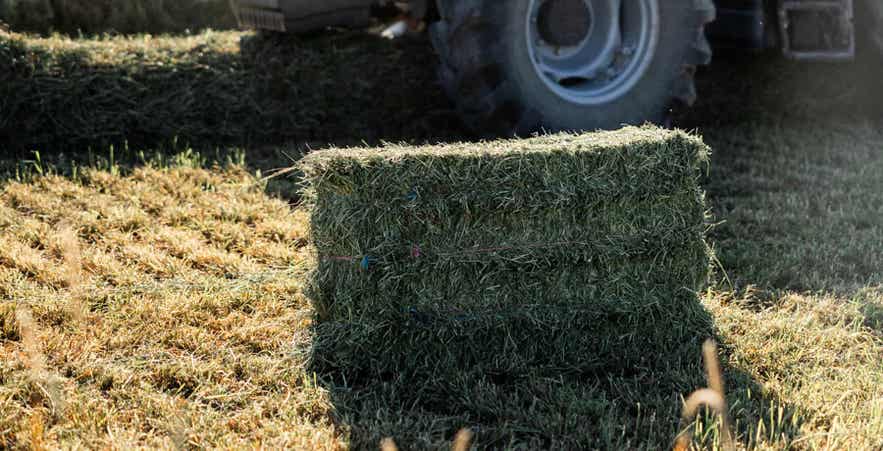
Two bales of hay can look nearly identical yet deliver very different amounts of usable energy to a horse. That gap usually starts in the field, long before the hay reaches a barn, and persists through storage and handling.
Harvest Maturity and Growing Conditions
As a forage plant matures, its cell walls thicken with structural fiber and lignin, and digestibility declines. Researchers evaluating digestibility prediction methods for horses confirmed that a hay’s nutritive value depends heavily on maturity at harvest and on growing conditions, not on plant species alone. [2]
Two products labeled the same way can have very different digestible energy, protein, and fiber values. These differences depend on how and when the plant was harvested and how it was handled immediately afterward. [1]
This variation can even show up within a single field, since growing conditions are rarely uniform from one section to the next. That is part of why a premium forage program relies on testing rather than a single visual impression of the crop. A single field can even ripen unevenly from one end to the other.
The Limitations of Visual Evaluation
Most horse owners are taught to judge hay quality by color, smell, and texture. These cues are useful as a starting point.
A 2025 study evaluating sensory assessment of hay samples found that an abnormal odor reliably predicted higher dust levels. Visible debris was associated with a greater likelihood of microbiological contamination. [3]
In that same study, sensory examinations rated only 28 percent of hay samples as fully adequate. Another 72 percent showed at least a minor hygiene deficiency, which a quick look and a sniff would not fully reveal.
Sensory checks remain a useful first filter, and horse owners should continue using them. But they can’t replace lab-verified nutrient content or a controlled production process. A premium forage program is designed to manage the variables that a nose and a pair of eyes cannot fully detect on their own.
Storage and Handling
Quality does not stop changing once hay leaves the field. How forage is stored, packaged, and transported also affects nutrient retention and hygiene.
Reviews of preserved forage feeding for horses point to production and storage practices as major sources of variation in quality, in addition to whatever happened at harvest. [1]
Forage stored improperly can absorb moisture, lose nutritional value, and develop hygiene problems that a sensory check may fail to detect. This is why premium forage programs treat storage and handling as part of the quality standard itself, not a separate concern.
Consistency across loads depends on controlling the entire path from field to feed room, not just at harvest. Hay that tests well at harvest can still develop dust and microbial issues linked to respiratory irritation if it absorbs moisture in storage.
How Premium Forage Supports Horse Health and Performance
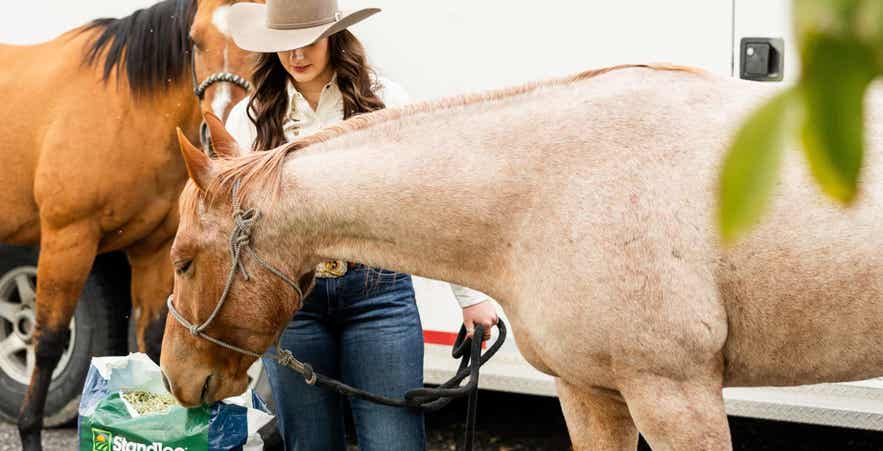
Individual hay quality matters. When that quality changes abruptly, it can significantly affect your horse’s health and performance.
Gastrointestinal Health
Horses are hindgut fermenters. The microbial population in the cecum and large intestine adapts slowly to a horse’s consistent diet. A sudden switch in hay type, cutting, or supplier can disrupt that balance. [1]
A scoping review of colic risk factors in adult horses across many published studies found that a change in diet, including a change in hay, was among the most reported risk factors for colic. [4]
This risk underscores the importance of supply stability. A commodity hay supply that varies unpredictably from load to load forces repeated dietary transitions. A horse’s gut was never built to absorb those transitions smoothly.
Senior, Metabolic, and Performance Horses
Performance horses depend on stable energy intake to maintain condition and recover properly between training and competition.
Senior horses and horses with metabolic sensitivities often have the least tolerance for unplanned changes in fiber, sugar, or starch content. Sugar and starch content can shift meaningfully between loads, even within the same forage species, depending on growing conditions at harvest.
For these horses, an unplanned jump in non-structural carbohydrates from a new load of hay is a management variable that a consistent, tested premium forage supply is specifically designed to control.
Comparing the Real Cost of Feeding Premium Forage
Cost comparisons between forage sources usually stop at price per bale or price per ton. That comparison leaves out how much usable nutrition a horse gets from that forage.
Nutrition Gaps and Supplementation
A lower-priced load of hay that is overly mature, coarse, or inconsistent often carries hidden costs that do not appear at the point of purchase. Horses sort through it and waste more of it, refusing the coarsest and least palatable portions first.
When digestibility is lower, more pounds are required to meet the same energy requirement. [2]
Gaps in nutrient content often require additional supplementation, adding cost and complexity to a feeding program. Those supplements compensate for what the hay is not reliably providing, from extra protein and minerals to extra calories to offset poor digestibility.
Premium Forage Saves Time and Money
Premium forage is priced to reflect the production standard behind it, not just the bag it comes in. When maturity, testing, and consistency are controlled at the source, horse owners spend less time compensating for what the forage does not provide. They also spend less money correcting problems that inconsistent quality created in the first place.
Consider two barns feeding the same number of horses the same daily amount of forage. One barn buys the least expensive hay available each month and adjusts grain and supplements to compensate for whatever gaps show up. The other buys a tested, consistent premium forage and rarely needs those corrections.
The second barn’s feed bill looks higher at the register. But once waste, supplementation, and the labor of constantly adjusting rations are counted, that gap often narrows considerably, and sometimes reverses.
A forage that costs more per bale but is consumed almost completely, tests consistently, and rarely needs a supplemental correction is often the better value.
How to Start Feeding Premium Forage
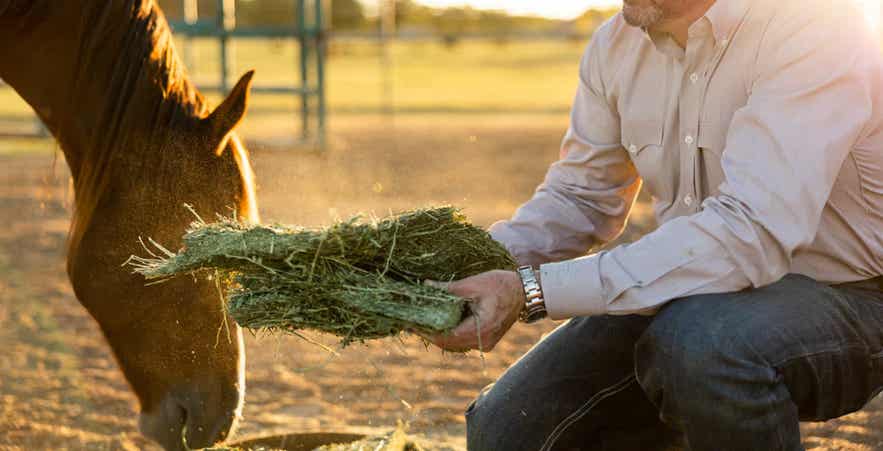
Understanding the difference between providing forage and feeding premium forage only matters if it changes how a feeding program gets evaluated.
Start by asking what a supplier can document, not just describe. A premium forage program should be able to explain how the forage is grown, harvested at the correct maturity, and tested.
Standlee’s standards outline exactly this documented, controlled process from field to feed room. The process is described in more detail in The Story Behind Standlee and Our Premium Forage.
Evaluate a forage supply for consistency, not just quality at a single point in time. Whenever possible, request a current forage analysis rather than relying on appearance alone. Lab testing removes the guesswork that a visual check cannot resolve on its own.
For horses already receiving good forage but needing extra support during transitions or shortages, How to Supplement Your Horse’s Diet with High-Quality Hay offers a practical next step.
Premium Forage Makes a Difference
Providing forage keeps a horse fed. Feeding premium forage means actively managing the variables that determine how forage affects a horse’s health and performance.
This distinction matters, especially for performance horses, senior horses, or any horse whose owner is tired of compensating for an inconsistent hay supply. Sourcing premium forage takes a bit more effort, but that effort pays off in a horse that holds weight, maintains optimal digestive function, and performs at their best.
For horse owners ready to compare their current feeding program with a defined premium standard, get started with the Standlee Forage Finder.
Frequently Asked Questions
Is premium forage just a marketing term for expensive hay?
No. Premium forage is a forage product managed to a defined standard. Those standards cover harvest maturity, nutrient density, hygiene, and consistency across loads, not simply a higher price point.
What is the real difference between hay and premium forage?
All premium forage is hay or a hay-based product, but not all hay meets premium standards. The difference comes down to how the forage was grown, harvested, tested, and stored. It also depends on how consistent it remains from one load to the next.
Can I tell forage quality just by looking at it?
A visual and smell check is a useful first filter, but research shows it does not catch every quality issue. Sensory checks are better at flagging hygiene problems such as dust and mold. They are less reliable for revealing nutrient content or digestibility.
Does forage quality really affect my horse’s health?
Yes. Forage digestibility and nutrient content vary with harvest maturity and growing conditions, and an inconsistent forage supply is linked to increased colic risk in horses. Both are quality and consistency issues, not merely feed preference.
Is premium forage worth the extra cost compared to standard hay?
Often, yes, once the cost per pound of usable nutrition is considered rather than the price per bale. Lower-quality forage frequently requires more supplementation, produces more waste, and delivers less digestible energy per pound.
How can I check if my current forage supply is consistent?
Request a current forage analysis from your supplier whenever possible, and track whether nutrient values stay stable across loads and seasons. A supplier who can document this consistency is operating closer to a premium standard.
Do pellets and cubes count as premium forage?
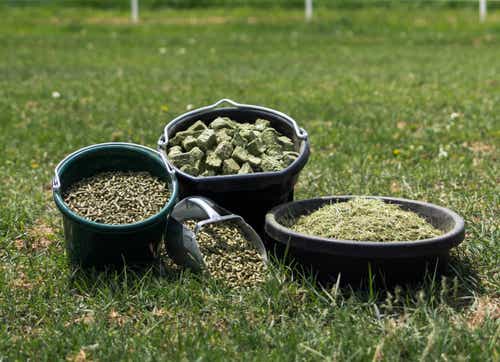
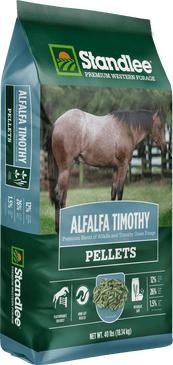
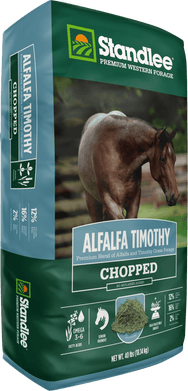
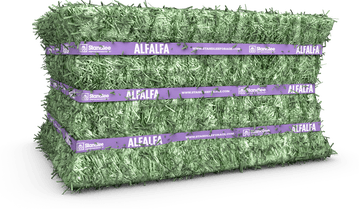
Yes, the form does not determine quality. Pellets, cubes, chopped forage, and compressed bales can all meet a premium standard when they are produced from properly harvested, tested forage, just as baled hay can.
What should I ask a forage supplier to determine if they provide premium quality?
Ask how the forage is harvested, what quality control or testing is performed, and how consistency is maintained across loads and seasons. A supplier providing true premium forage should be able to answer all three questions clearly.
References
- Harris PA, et al. Review: Feeding conserved forage to horses: recent advances and recommendations. Animal. 2017.
- Andueza D, Martin-Rosset W. Prediction of the digestibility and digestible energy content of hay for horses using an enzymatic degradability method. Animal. 2025.
- Bouverat VMA, et al. Sensory Assessment of Hay Samples: Abnormal Odor Predicts Increased Dust Levels and Impurities Suggest Microbiological Contamination. Animals. 2025.
- Curtis L, et al. Risk factors for acute abdominal pain (colic) in the adult horse: A scoping review of risk factors, and a systematic review of the effect of management-related changes. PLoS One. 2019.
Additional Learning Resources
From the Standlee Barn Bulletin Blog
- What Makes High-Quality Forage? A Hay Buyer’s Guide
- The Story Behind Standlee and Our Premium Forage
From the Standlee Beyond the Barn Podcast
From the Standlee Nutritional Papers
Products featured in this post
Enjoying the Standlee blog?
Subscribe to Standlee emails and get our newest content (and coupons, offers, and other great stuff) sent to your inbox!
Subscribe Now